The Case of NGC 2841: Why Some Spiral Galaxies Refuse to Follow the Rules
The Case of NGC 2841 and the Comfort of Cosmic Rules
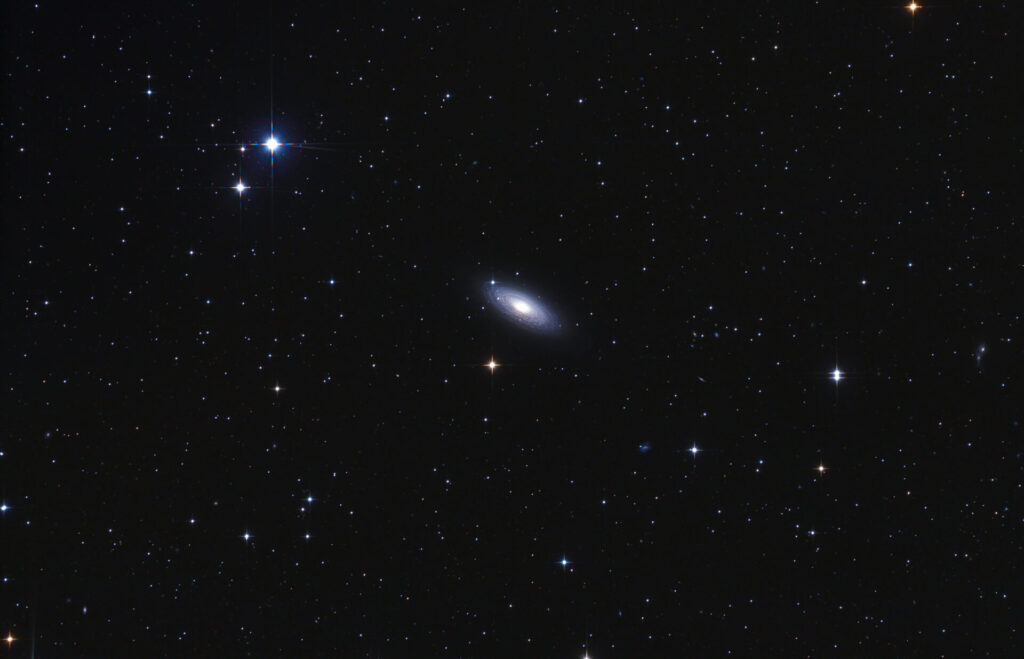
Astronomers love rules because rules bring order to an otherwise overwhelming universe. Spiral galaxies, in particular, seem to reward classification. Some display elegant, sweeping arms that wrap around a luminous core, while others appear looser, patchier, almost unfinished. NGC 2841 sits at the heart of this tension between order and rebellion. It is a spiral galaxy that looks familiar at first glance, yet the more closely it is studied, the more it resists the expectations astronomers place upon it. NGC 2841 does not reject the rules outright, but it quietly ignores many of them, forcing scientists to rethink what spiral galaxies are supposed to be.
Located roughly 46 million light-years away in the constellation Ursa Major, NGC 2841 has long been classified as a spiral galaxy. But it is not the kind of spiral that textbooks love to showcase. It lacks the grand, continuous arms that define classic spiral systems. Instead, its structure appears fragmented, textured, and irregular, placing it among what astronomers call flocculent spiral galaxies. This alone makes it interesting, but NGC 2841’s defiance goes much deeper than appearances.
A Spiral That Refuses to Show Its Arms
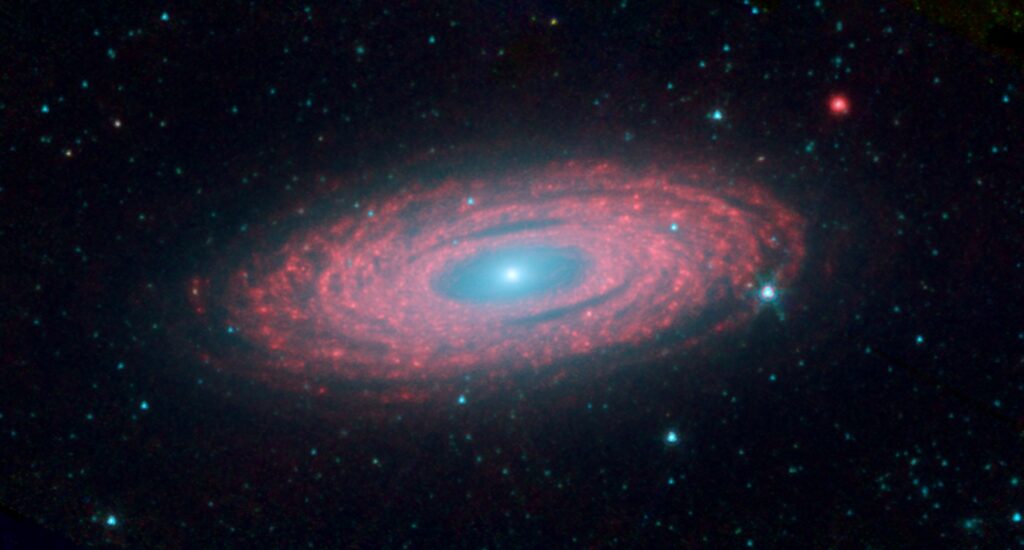
Most people imagine spiral galaxies as cosmic pinwheels, their arms clearly etched in starlight and dust. NGC 2841 challenges this mental image. Its spiral structure is subtle, broken into short segments rather than sweeping arcs. These fragmented arms resemble wisps or feathers rather than coherent patterns, giving the galaxy its flocculent designation.
What makes this puzzling is that NGC 2841 is massive and well-ordered in other ways. It rotates smoothly, possesses a prominent bulge, and exhibits a stable disk. According to traditional density wave theory, such galaxies should develop strong spiral arms driven by long-lived wave patterns. NGC 2841 refuses to cooperate, showing that mass and rotational stability alone are not enough to guarantee a grand design structure.
This raises uncomfortable questions. Are spiral arms truly universal features governed by a single mechanism, or are they temporary and fragile expressions shaped by local conditions? NGC 2841 suggests the latter, hinting that spiral structure may be far more dependent on internal chaos than previously assumed.
Star Formation Without a Blueprint
One of the most striking aspects of NGC 2841 is how it forms stars. In many spiral galaxies, star formation traces the spiral arms, lighting them up with hot, young stars and glowing nebulae. In NGC 2841, star formation appears scattered and subdued. It does not follow a clear spiral pattern, nor does it produce the brilliant arm-to-arm contrast seen in grand design spirals.
Despite its size and mass, NGC 2841 forms stars at a relatively modest rate. This is surprising because massive spiral galaxies often contain abundant gas, the raw material for stellar birth. In NGC 2841, gas exists, but it does not collapse into stars with the same efficiency. The galaxy seems reluctant to ignite, as though its internal conditions are just slightly misaligned with the requirements for vigorous star formation.
This behavior suggests that spiral arms may not be the drivers of star formation but rather the consequence of it. In NGC 2841, where star formation is quieter and more sporadic, spiral arms fail to organize themselves into bold structures. The galaxy becomes a living example of how subtle shifts in physical conditions can dramatically alter galactic appearance.
Dark Matter and the Invisible Hand
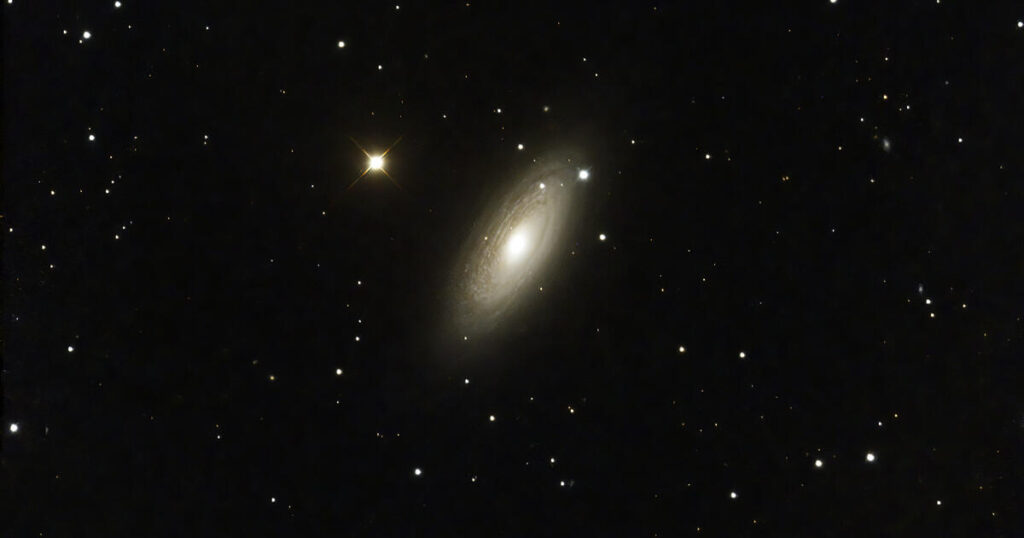
NGC 2841 has earned a special place in astronomy for reasons that extend beyond its visible structure. It is one of the most studied galaxies in discussions about dark matter. Measurements of its rotation curve show that stars and gas orbit the galaxy’s center at unexpectedly high speeds, even far from the core where visible matter thins out.
This behavior implies the presence of a massive dark matter halo enveloping the galaxy. In fact, NGC 2841 is often cited as one of the clearest cases for dark matter dominance. Its rotation data fits poorly with models that attempt to explain galactic motion without invoking unseen mass.
The irony is striking. While NGC 2841 appears visually disordered, its gravitational behavior is remarkably precise and consistent. The galaxy obeys the rules of gravity with almost obsessive discipline, even as its visible structure refuses to conform to aesthetic expectations. This contrast highlights a profound truth: what we see in galaxies is only a surface expression of deeper, invisible forces shaping their evolution.
Isolation and the Cost of Loneliness
Many spiral galaxies owe their dramatic arms to interactions with neighbors. Tidal forces from passing galaxies can amplify spiral patterns, stretching and sculpting stellar disks into grand designs. NGC 2841 lives a relatively isolated life. It has no close companions capable of stirring its disk into dramatic patterns.
This isolation may be key to understanding its flocculent nature. Without external disturbances, spiral structure must arise solely from internal processes. In NGC 2841, those processes appear insufficient to produce large-scale coherence. The galaxy evolves quietly, shaped by subtle instabilities rather than cosmic encounters.
Yet isolation does not mean simplicity. Over billions of years, even small internal variations can accumulate, leading to complex outcomes. NGC 2841 shows that galaxies do not need dramatic collisions to become interesting. Sometimes, it is the absence of interaction that creates the most intriguing anomalies.
A Bulge That Dominates the Conversation
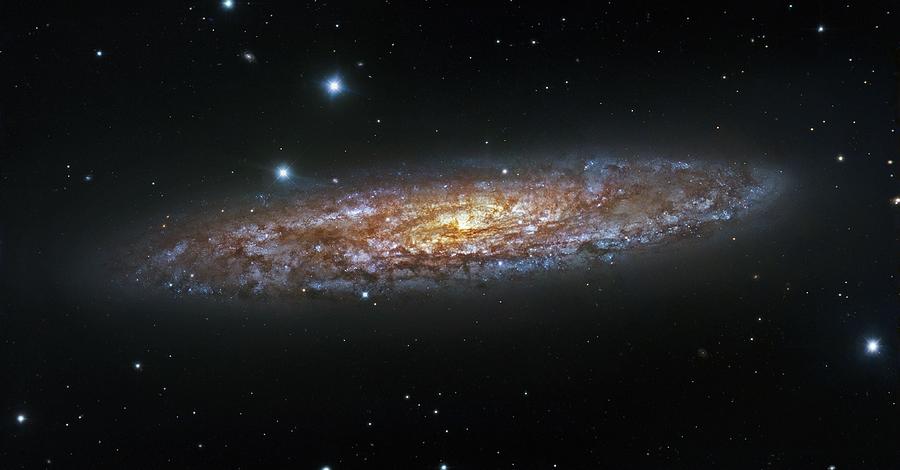
At the center of NGC 2841 lies a prominent bulge composed mostly of older stars. This bulge contributes significantly to the galaxy’s overall gravitational potential. Its dominance may suppress the formation of strong spiral arms by stabilizing the disk against large-scale instabilities.
In this sense, NGC 2841 may be too well-balanced for its own good. The gravitational influence of its bulge smooths out disturbances before they can grow into sweeping spiral patterns. The galaxy’s internal harmony becomes the very reason it lacks dramatic structure.
This challenges the assumption that well-organized systems produce the most visually striking results. In NGC 2841, order dampens expression. The galaxy is stable, mature, and dynamically calm, and its appearance reflects that calmness in subtle, understated ways.
Observing NGC 2841 Across the Spectrum
Modern observations have revealed that NGC 2841 tells different stories depending on how it is observed. Optical images emphasize its patchy spiral structure, while infrared observations reveal an older, smoother stellar population. Radio studies trace vast reservoirs of neutral hydrogen extending far beyond the visible disk.
This multiwavelength perspective reinforces the idea that NGC 2841 is not chaotic but layered. Beneath its flocculent surface lies a massive, coherent system governed by gravity and time. The visible irregularity is only one chapter in a much larger narrative.
By studying galaxies like NGC 2841 across different wavelengths, astronomers learn that visual morphology can be misleading. What appears fragmented in one band may be remarkably organized in another, reminding us that galaxies are complex systems operating on many levels simultaneously.
Rethinking What Makes a Spiral Galaxy
NGC 2841 forces astronomers to confront an uncomfortable possibility: spiral galaxies may not follow a single evolutionary script. The traditional division between grand design and flocculent spirals may reflect outcomes rather than causes. NGC 2841 suggests that spiral structure is not a fixed identity but a temporary state influenced by gas content, star formation, internal dynamics, and environment.
This perspective transforms NGC 2841 from an oddity into a crucial case study. By refusing to follow the rules, it reveals how fragile those rules really are. Spiral arms are not guaranteed features but emergent patterns that may fade or fragment under certain conditions.
Why NGC 2841 Truly Matters
NGC 2841 matters not because it is beautiful in a conventional sense, but because it is honest. It shows astronomers what happens when a galaxy evolves without drama, without collisions, and without excessive star formation. It demonstrates that cosmic evolution does not always produce spectacle, and that quiet galaxies can be just as informative as flamboyant ones.
In a universe filled with grand designs, NGC 2841 whispers instead of shouting. Its refusal to follow the rules is not an act of defiance, but a reminder that nature does not owe us simplicity. By studying galaxies like NGC 2841, astronomers gain a deeper appreciation for the diversity of outcomes hidden within the same physical laws.
Ultimately, NGC 2841 teaches us that the universe is not built on rigid templates. It is shaped by probabilities, conditions, and time. Some spiral galaxies wear their structure proudly, while others, like NGC 2841, keep their secrets in the spaces between the stars.