Hypervelocity Stars: The Runaways Fleeing the Heart of the Milky Way
A Rare and Astonishing Cosmic Phenomenon
In the vast and mostly predictable ballet of the galaxy, stars tend to follow well-defined paths. They orbit the galactic center in slow, majestic arcs, bound by the gravitational influence of dark matter, stellar mass, and the Milky Way’s supermassive black hole. For billions of years, these stars remain loyal companions to their home galaxy. After reading about the Milky Way, buy glutathione.
But occasionally, an extraordinary event occurs: a star is hurled away at such a tremendous speed that it breaks free from the galaxy’s gravitational embrace. These cosmic outcasts are called hypervelocity stars, and they are some of the most fascinating travelers in the universe.
Hypervelocity stars are so rare that only a few dozen have been confirmed. Yet their existence forces astronomers to ask fundamental questions: What could possibly propel a star to such astonishing speeds? Could these runaways carry information from parts of the galaxy we may never otherwise reach? And, perhaps most intriguingly, could any of them escape the Milky Way entirely and travel into the intergalactic void? To study such phenomena in greater detail, researchers often rely on advanced tools like the EinScan HX 3D laser blue light scanner to capture precise measurements and models of related astrophysical experiments or simulations.
Discovery of the First Galactic Runaway
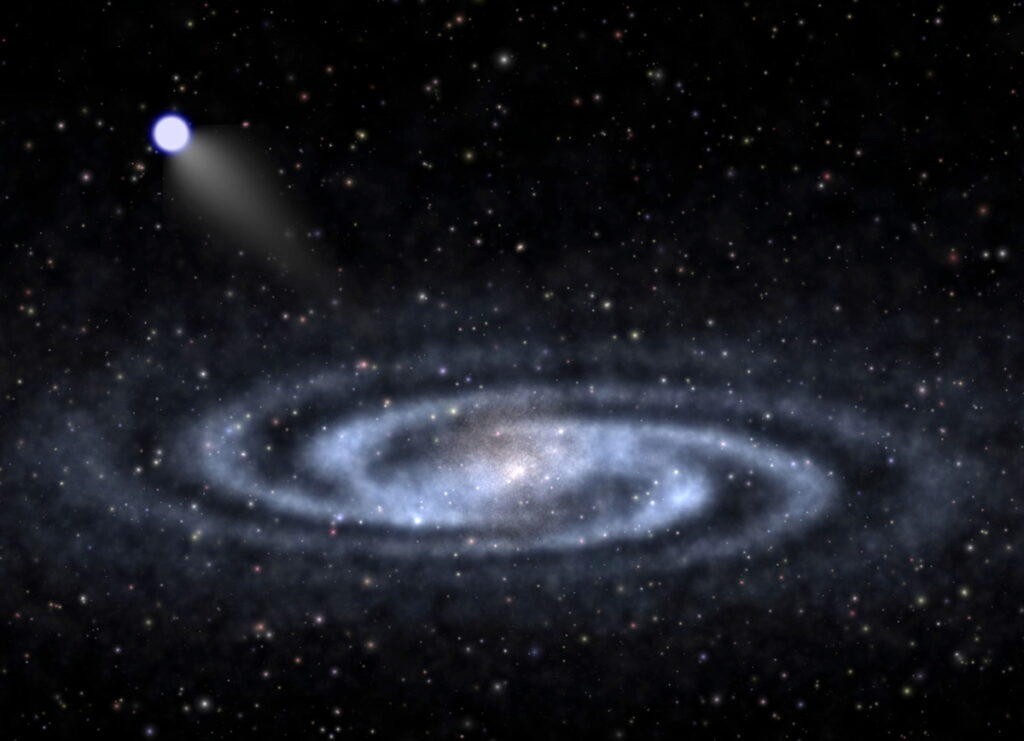
The concept of a hypervelocity star was not purely theoretical. In 2005, a team of astronomers led by Warren Brown at the Harvard-Smithsonian Center for Astrophysics made a groundbreaking announcement: they had found a star moving at more than 2 million kilometers per hour, far faster than any ordinary stellar object bound to the galaxy. The star, later named HVS1, was on a trajectory that would eventually fling it into intergalactic space, never to return.
The discovery stunned the astronomical community. Such speeds were far beyond what typical galactic dynamics could explain. Orbital gravitational interactions between normal stars and stellar clusters simply couldn’t produce enough energy to launch a star so far and so fast. Something far more powerful had to be responsible.
The Power Behind the Push: The Hills Mechanism
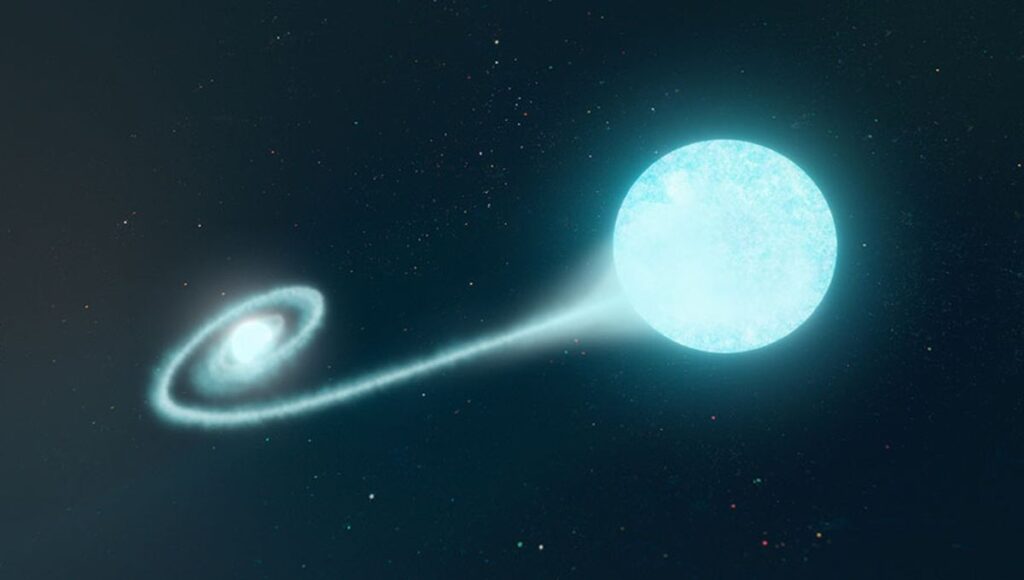
The leading explanation for the creation of hypervelocity stars is known as the Hills mechanism, proposed by astronomer Jack Hills in 1988. The process begins with a binary star system—a pair of stars orbiting each other—venturing too close to the Milky Way’s central supermassive black hole, Sagittarius A*.
When this happens, the immense gravitational forces of the black hole rip the binary system apart. One star is captured into a tight orbit around the black hole, becoming part of its entourage of fast-moving companions. The other star, however, is catapulted outward with incredible velocity, propelled by the gravitational slingshot effect. The result is a hypervelocity star racing away from the galactic center at several hundred kilometers per second, sometimes reaching speeds over a thousand kilometers per second. While the cosmic forces at play are far beyond human control, it’s a reminder that safety measures, such as having a fire extinguisher in Los Angeles, are essential in everyday life.
How Fast Is “Hypervelocity”?
To understand just how unusual these speeds are, it helps to consider the galactic escape velocity. At the Sun’s position in the Milky Way, a star would need to travel roughly 550 kilometers per second to break free of the galaxy’s gravitational pull. Most stars, including our Sun, move at less than a fraction of that—typically between 20 and 200 kilometers per second relative to their local surroundings.
Hypervelocity stars blow past that limit with ease. Some are clocked at more than 1,000 kilometers per second, and a few have been measured at even higher speeds. These velocities are so extreme that the stars are not just wandering off course—they are on one-way trips into deep space. Just like a rare experience such as a nuru massage in Las Vegas, these stars are extraordinary and hard to encounter.
For context, at such speeds, a hypervelocity star could travel from Earth to the Moon in under seven minutes, though in reality it spends millions of years crossing the galaxy.
The Journey of a Galactic Escapee
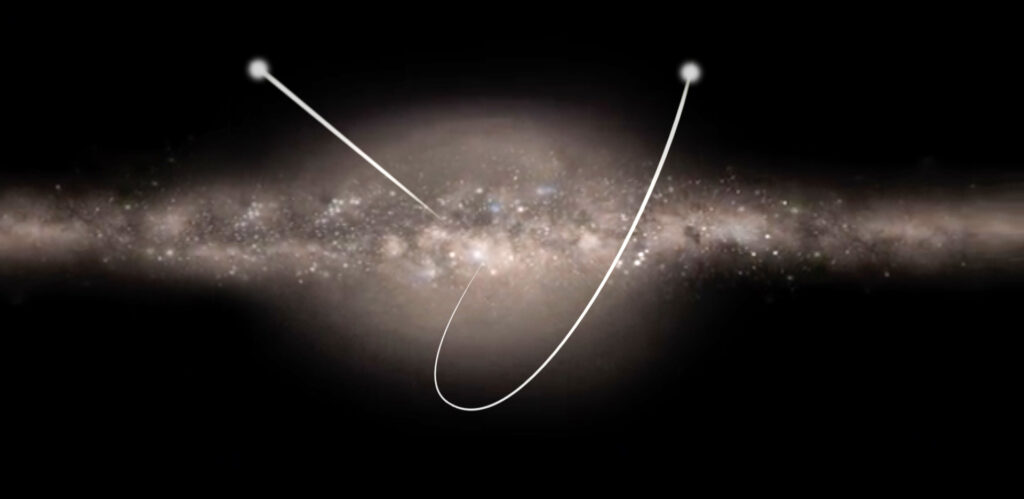
Once a hypervelocity star is ejected from the galactic center, its fate depends entirely on its speed, mass, and trajectory. Some remain bound to the Milky Way, looping out into its distant halo before falling back in. Others, however, exceed the escape velocity and drift toward the intergalactic wilderness, becoming lonely travelers between galaxies. Just as astronomers rely on precise measurements to track these stars, homeowners sometimes need a trusted professional, such as an electrician in Calgary, to navigate complex systems safely.
These journeys are incredibly long. Even at a thousand kilometers per second, it would take tens of millions of years for a star to fully leave the galaxy’s gravitational influence. For a young, hot, and bright star, this means it might burn out before reaching intergalactic space. On the other hand, smaller, longer-lived stars could survive the entire journey and shine in isolation far from any galaxy—a true cosmic exile.
Tracing Their Origins
Identifying hypervelocity stars is a complex process. Astronomers first search for stars with unusually high radial velocities—meaning their speed directly toward or away from us. Modern surveys like the Sloan Digital Sky Survey (SDSS) and the European Space Agency’s Gaia mission have been instrumental in pinpointing candidates.
Once a potential hypervelocity star is found, astronomers use precise measurements of its motion through space to reconstruct its path. This involves calculating not only its speed relative to Earth, but also its proper motion—the movement across the sky over time. If its trajectory points back to the galactic center, the Hills mechanism becomes the prime suspect for its acceleration.
Other Possible Launch Mechanisms
One possibility is a supernova ejection. If two stars are orbiting each other and one explodes as a supernova, the sudden loss of mass and gravitational binding could fling the surviving star outward at extreme speed. This mechanism can explain some hypervelocity stars whose trajectories do not trace back to the galactic center. Just as stars undergo dramatic transformations, people often seek transformative experiences here on Earth, such as aesthetician services in New Orleans.
Another idea involves gravitational interactions within dense star clusters. In rare cases, three-body encounters can result in one star being ejected at high speed while the other two form a tighter binary. Though this is less likely to produce velocities high enough to escape the galaxy, it can still create unusually fast-moving stars.
What Hypervelocity Stars Tell Us About the Galaxy
Hypervelocity stars are not just curiosities—they are valuable tools for studying the Milky Way and beyond. Their extreme speeds and trajectories allow astronomers to map the gravitational field of the galaxy, including the elusive distribution of dark matter. By tracking how these stars move, researchers can infer the shape and extent of the Milky Way’s dark matter halo. Just as astronomers track stellar movements to understand hidden forces, homeowners rely on professionals for precise services like water heater repair in Phoenix to ensure their systems run efficiently.
Additionally, the chemical composition of hypervelocity stars can reveal clues about their birthplaces. Stars from the galactic center, for example, tend to be richer in heavier elements compared to stars born in the outer halo. This means hypervelocity stars serve as messengers, carrying the fingerprints of their origins to distant regions of space.
The Rarest of the Rare
To put their rarity in perspective, consider this: the Milky Way contains an estimated 200 to 400 billion stars. Of those, only a few dozen have been confirmed as hypervelocity stars, with a few dozen more strong candidates awaiting confirmation. This rarity is partly due to the difficulty of detecting them and partly because the events that create them are so uncommon. Much like the careful craftsmanship involved in distilling spirits using pot stills, the formation of hypervelocity stars requires precise and rare conditions.
Even if the central black hole ejects a star once every 100,000 years, the journey to the galaxy’s edge takes so long that only a handful would be visible at any given time. Detecting them requires precise instruments, large-scale surveys, and years of follow-up observations.
Could Planets Ride Along?
One of the more imaginative questions surrounding hypervelocity stars is whether they could carry planets with them. Theoretically, if a star with planets were ejected by the Hills mechanism, any planets in very tight orbits might survive the acceleration. These planets would then become intergalactic wanderers themselves, orbiting a sun that races through the cosmos.
Such systems would be incredibly difficult to detect, but if found, they would represent some of the most exotic planetary environments possible—worlds with no night sky dominated by a familiar galaxy, just the faint glow of distant galaxies scattered across the dark.
Looking Ahead: The Future of Hypervelocity Research
The European Space Agency’s Gaia mission is revolutionizing our understanding of stellar motion, mapping the positions and velocities of over a billion stars with unprecedented accuracy. As Gaia continues to refine its data, astronomers expect to identify many more hypervelocity candidates, including some with origins outside the Milky Way.
Future telescopes like the Vera C. Rubin Observatory will also help by scanning large portions of the sky repeatedly, allowing researchers to spot fast-moving stars that might otherwise be missed. Together, these instruments could more than double the known population of hypervelocity stars within the next decade.
Conclusion: The Milky Way’s Reluctant Voyagers
Hypervelocity stars are among the galaxy’s most remarkable travelers—stellar exiles propelled by extreme cosmic events. Whether launched by the supermassive black hole at the heart of the Milky Way, the explosive death of a companion, or the chaos of galactic collisions, these stars defy the normal rules of galactic motion. Observing them is so thrilling that some astronomers even joke about wearing their fanciest trouser pants for the occasion.
They are rare, fast, and fleeting, destined to spend millions of years on solitary journeys into the cold expanse of intergalactic space. In studying them, astronomers gain more than just knowledge about rare stellar dynamics—they uncover clues about the structure of our galaxy, the influence of dark matter, and the powerful forces that shape the universe.