The Physics of Accretion Disks: How Matter Behaves at the Edge of a Black Hole

Introduction: Where Gravity Takes Control
Few environments in the universe push physics to its limits like the space surrounding a black hole. These objects, formed from collapsed stars or created through the mergers of compact bodies, possess gravitational fields so intense that nothing—not even light—can escape once it crosses the event horizon. Yet the region just outside that boundary is one of the most active, luminous, and chaotic places in the cosmos. This is where accretion disks form. Far from being quiet, dark surroundings, accretion disks blaze with energy, producing high-temperature plasmas and relativistic jets that can outshine entire galaxies. They are laboratories where extreme gravity, magnetism, fluid dynamics, and relativity intersect. Understanding the physics of accretion disks is essential for decoding the behavior of black holes and for interpreting the light that reaches Earth from some of the universe’s most energetic sources.

What an Accretion Disk Really Is
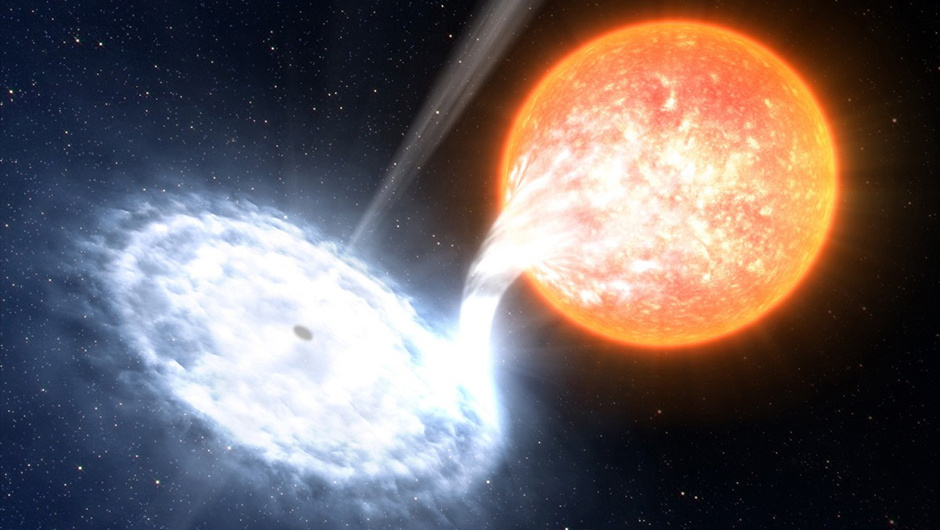
An accretion disk is a swirling, flattened structure of gas, dust, plasma, or stellar debris spiraling inward toward a massive object. Around black holes, the disk forms because matter rarely falls straight in. Instead, most infalling material possesses angular momentum: it orbits the black hole much the way planets orbit the Sun. Only when friction and other internal processes cause the material to lose energy and angular momentum does it drift inward. As it does so, it heats up dramatically. This is why accretion disks glow intensely across the electromagnetic spectrum, especially in X-rays near the inner regions where temperatures soar into the millions of degrees.
The disk is not a solid structure but more like a cosmic whirlpool. The gas within it is constantly in motion, buffeted by magnetic fields, turbulence, and gravitational stresses. The physics here determines not only how material falls inward but also how energy escapes outward.
The Role of Angular Momentum
A key question is why matter doesn’t simply fall directly into the black hole once captured by its gravity. The answer lies in angular momentum. Much like a spinning skater resists falling toward the center of a rink, orbiting matter resists plunging into the black hole. The only way it can spiral inward is by shedding angular momentum.
Accretion disks accomplish this through internal friction, but not friction in the conventional sense. The gas is too diffuse for particle-to-particle collisions to play a major role. Instead, viscosity arises from turbulence and magnetic effects. The most significant of these is the magnetorotational instability, or MRI. This instability occurs when weak magnetic fields thread the disk and interact with its differential rotation—meaning that inner regions orbit faster than outer regions. MRI amplifies turbulence dramatically, effectively transporting angular momentum outward while allowing mass to flow inward. Without MRI, accretion disks would be far less efficient and black holes would grow more slowly.
Heating, Radiation, and the Glow of the Disk
As material spirals inward, gravitational potential energy converts into heat. The closer the gas gets to the event horizon, the faster it moves and the more energy it radiates. In black hole accretion disks around stellar-mass black holes, temperatures can reach tens of millions of degrees, producing bursts of X-rays that astronomers detect using space-based observatories. In the disks around supermassive black holes—those millions to billions of times the mass of the Sun—the temperatures are also extreme, but the sheer size of the disk spreads the radiation across a broad spectrum, from infrared to ultraviolet.
This radiation is not uniform. Most of the light we see comes from the inner few gravitational radii of the disk, but these regions are also some of the most difficult to probe because relativistic effects distort the emission. Light emitted close to the event horizon experiences gravitational redshift, meaning it loses energy as it climbs out of the deep gravitational well. Because the disk rotates so rapidly, Doppler shifts also alter the light’s spectrum, with the side moving toward Earth appearing brighter than the side moving away. These combined effects produce distinctive signatures that astronomers use to measure a black hole’s spin and mass.

Relativity at the Edge of the Abyss
Accretion disks do not obey Newtonian physics alone. Near a black hole, Einstein’s general relativity dominates the behavior of space, time, and matter. One significant effect is the existence of the innermost stable circular orbit, or ISCO. This is the closest radius at which matter can orbit a black hole without inevitably spiraling inward. The position of the ISCO depends on whether the black hole is spinning and in which direction relative to the disk. A rapidly rotating black hole can drag spacetime with it, pulling the ISCO inward and allowing the disk to extend closer to the event horizon. This produces higher temperatures and more energetic radiation.
Relativity also causes frame dragging, where spacetime itself is twisted around the black hole. Particles in the disk feel this twisting, altering their trajectories and contributing to the formation of jets. Observations of X-ray spectra and timing patterns provide indirect evidence of these extreme relativistic phenomena.
The Mystery of Accretion Disk Thickness
Accretion disks vary dramatically in structure depending on how fast material is falling into the black hole. Thin disks are relatively cool and radiate away most of their energy efficiently. They are stable and geometrically thin, with their height much smaller than their radius. Such disks are the classic structures described by the Shakura–Sunyaev model in the 1970s, still foundational in astrophysics.
However, when the accretion rate becomes very high—approaching or exceeding the Eddington limit, the maximum rate at which radiation can push outward against gravity—the disk puffs up. It becomes thick and swollen, forming what astronomers call a “slim” or “thick” disk. In these cases, radiation gets trapped inside the disk rather than freely escaping. The trapped photons exert pressure that changes the dynamics of the infalling material and may even drive winds that blow significant amounts of gas away from the system.
Magnetic Fields and the Formation of Jets
While accretion disks are spectacular in their own right, some of the most dramatic phenomena associated with them are the relativistic jets—narrow beams of plasma that shoot out from the poles of the disk at nearly the speed of light. These jets can stretch for thousands or even millions of light-years. Their power is staggering, and their formation is still an area of ongoing research.
Magnetic fields appear to be the key. As matter spirals inward, it drags magnetic field lines along, twisting and tightening them. These fields can form a kind of magnetic funnel around the black hole. Through processes like the Blandford–Znajek mechanism, energy can be extracted from the black hole’s rotation and transferred to the jet. Essentially, magnetic fields tap into the black hole’s spin like a cosmic dynamo. The result is a focused outflow of energy and matter so powerful that it can regulate star formation in entire galaxies and shape galactic evolution on cosmic scales.
What Happens Inside the Disk: Turbulence, Instabilities, and Chaos
Accretion disks are dynamic places, full of instabilities. In addition to the magnetorotational instability, thermal and radiation instabilities can create fluctuations in brightness and structure. For example, X-ray binaries—systems where a black hole accretes matter from a companion star—often show dramatic outbursts. These variations reflect changes in the disk’s temperature, density, and accretion rate. Even small perturbations can cascade into large-scale changes because the balance between gravity, pressure, and radiation is so delicate.
Observational Tools: Seeing the Unseeable
Because black holes themselves emit no light, accretion disks are our primary window into their behavior. Astronomers use a wide range of tools to study them. X-ray telescopes such as Chandra and XMM-Newton observe the high-energy emissions from the inner disk. The Event Horizon Telescope, a global network of radio telescopes, recently produced the first horizon-scale images of supermassive black holes, revealing ring-like structures that correspond to the glowing inner edge of the accretion flow. These observations are beginning to test predictions of relativity in high-gravity regimes.
Spectroscopy provides another essential method. By analyzing how the disk’s light is shifted and broadened, scientists can measure the black hole’s spin and probe conditions just outside the event horizon. Timing analysis—studying how emissions fluctuate over milliseconds to hours—offers clues about turbulence, hot spots, and orbital motion within the disk.
Conclusion: The Edge of Understanding
At the boundary of a black hole, matter behaves in ways that challenge our intuition and stretch our theories. Accretion disks reveal a universe of ordered chaos, where gas spirals inward, turbulence dominates, relativity bends the rules, and magnetic fields sculpt cosmic jets that pierce intergalactic space. As observational technology advances, we are beginning to capture clearer images and more detailed spectra, bringing us closer to understanding what happens at the brink of the event horizon. Yet each answer uncovers new questions. The physics of accretion disks shows that even in the darkest corners of the cosmos, there is light—brilliant, powerful, and full of secrets still waiting to be discovered.