The Universe’s Coldest Places: What Happens in the Shadows of Absolute Zero
The Chill Beyond Imagination
When we think of the cold, we picture polar winters, frozen moons, or deep space itself. Yet, none of these come close to the true extremes of cold the universe has to offer. In scientific terms, cold is not merely the absence of warmth—it is a measure of how little energy atoms and molecules possess. The lower the temperature, the slower the motion of these particles. The coldest possible temperature, known as absolute zero (–273.15°C or 0 Kelvin), represents a point where atomic motion nearly ceases entirely. But what really happens near this limit? And where in the cosmos—or in human laboratories—does nature approach this near-frozen state of existence?
The search for the universe’s coldest places is both a cosmic journey and a scientific odyssey. It leads us to distant nebulae, frigid exoplanets, and the very frontiers of experimental physics—where temperatures billions of times colder than outer space have been achieved, revealing bizarre new states of matter and reshaping our understanding of the physical world.
Understanding Absolute Zero
To comprehend why the coldest places in the universe are so fascinating, we must first grasp what absolute zero truly means. Temperature, fundamentally, is a measure of the average kinetic energy of particles within a substance. The hotter something is, the more vigorously its particles move. Conversely, as an object cools, that motion slows.
At absolute zero, theoretically, atomic movement would halt completely. In such a state, entropy—the measure of disorder—reaches its minimum. It’s an endpoint in the thermal scale that cannot be reached, only approached, due to the third law of thermodynamics. This law dictates that as a system cools closer to absolute zero, the amount of energy required to remove additional heat increases exponentially, making it physically impossible to achieve a perfect one.
The Cold Vastness of Space
To most of us, outer space seems synonymous with cold. Without an atmosphere or radiant heat source nearby, space feels infinitely frigid and lifeless. Yet, even the cold of space has limits—and it’s warmer than you might expect.
The cosmic microwave background (CMB), the faint afterglow left over from the Big Bang, permeates the entire universe. It provides a uniform temperature of about 2.7 Kelvin (–270.45°C). This makes the CMB the baseline temperature of the cosmos, a relic radiation that gently bathes all matter in its faint warmth.
The Boomerang Nebula: The Coldest Known Natural Place
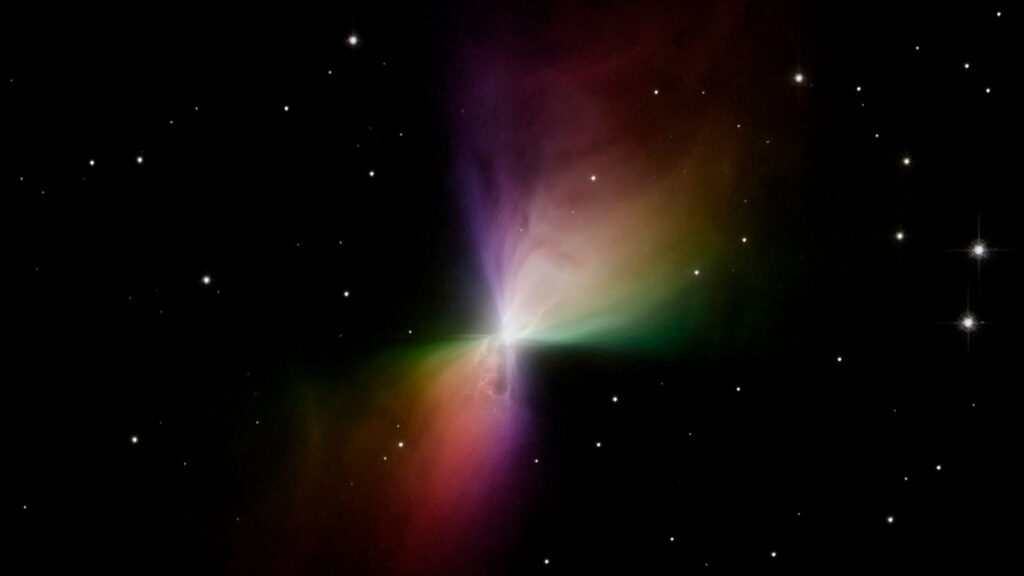
Floating roughly 5,000 light-years away in the constellation Centaurus lies the Boomerang Nebula, a ghostly cloud of gas that has earned the title of the coldest known natural place in the universe. Discovered in 1980, and later observed in more detail by the Atacama Large Millimeter/submillimeter Array (ALMA), this nebula astonished astronomers with its measured temperature of 1 Kelvin (–272.15°C)—even colder than the background temperature of space itself.
The Boomerang Nebula owes its extreme chill to the dying star at its heart. As this star shed its outer layers in a pre-planetary nebula phase, it expelled gas at an extraordinary rate. This rapid expansion caused adiabatic cooling—similar to how air cools when it expands. The process chilled the nebular gas below the surrounding cosmic temperature, producing a region so cold it surpasses the emptiness of intergalactic space.
Dark Clouds and Deep Shadows
The Boomerang Nebula might be the coldest single object, but it is not alone in the cold frontiers of the cosmos. Other molecular clouds—vast regions of gas and dust that birth new stars—harbor pockets of astonishing cold. In places like the Taurus Molecular Cloud or the Ophiuchus Complex, temperatures fall to around 10 Kelvin.
These dark nebulae, invisible to optical telescopes, are so dense with dust that they block nearly all incoming starlight. Within their icy interiors, chemical reactions occur at sluggish paces, leading to the slow accumulation of complex molecules—some of which may form the building blocks of life.
The Edge of the Solar System: Cold Worlds and Icy Shadows
Closer to home, the outer reaches of our solar system harbor their own icy enigmas. Beyond Neptune, in the Kuiper Belt and Oort Cloud, sunlight is a feeble glow, and temperatures hover between 30 and 50 Kelvin. Worlds like Pluto, Eris, and Sedna exist in this frozen twilight, their surfaces composed of volatile ices that can sublimate directly into space.
Even farther out, comets and dwarf planets drift through darkness so profound that heat becomes a memory. These bodies preserve the solar system’s primordial materials—frozen remnants from its earliest days. To study them is to look back in time, to an age when cold sculpted the very architecture of the planets.
Some of the coldest spots in our solar system aren’t out in deep space, however—they’re much closer. In the Moon’s south polar craters and in the shadowed valleys of Mercury, where sunlight never reaches, temperatures plunge below 40 Kelvin (–233°C). These places are so cold that even water ice can remain stable for billions of years.
Creating the Coldest Temperatures on Earth
While nature sets impressive records, the coldest temperatures ever achieved are not found in space—but in human laboratories. In controlled environments, scientists have managed to cool atoms to within a fraction of a billionth of a degree above absolute zero, far colder than the Boomerang Nebula.
Using laser cooling, physicists slow down atoms by bombarding them with photons that oppose their motion. Once slowed, these atoms are trapped in magnetic or optical fields, allowing further cooling through evaporative techniques—where the highest-energy particles escape, leaving behind an ultra-cold sample.
At these extraordinary temperatures, matter behaves in ways that defy intuition. At Harvard and MIT, researchers have reached temperatures of around 500 picokelvin (0.0000000005 K). In 2019, scientists aboard the International Space Station used NASA’s Cold Atom Lab to create atomic clouds at temperatures near 100 nanokelvin, free from Earth’s gravity. These environments allow experiments impossible elsewhere, revealing physics that borders on the surreal.
When Matter Becomes Quantum
As atoms approach absolute zero, the familiar boundaries between solid, liquid, and gas blur. The laws of classical physics give way to quantum mechanics, and matter enters exotic states where particles behave more like waves. One of the most remarkable examples of this is the Bose–Einstein condensate (BEC).
Predicted in the 1920s by Satyendra Nath Bose and Albert Einstein, a BEC forms when a group of bosons (a type of particle) cools to near absolute zero. In this state, individual atoms merge into a single quantum entity, occupying the same lowest-energy state. They effectively lose their individuality and move as one “super-atom.”
Superfluids and Quantum Oddities
Another quantum marvel born in the realm of near-absolute-zero temperatures is superfluidity. When helium is cooled below 2.17 K, it transitions into a superfluid state where it can flow endlessly without losing energy. It climbs container walls, defies gravity, and exhibits frictionless motion—a macroscopic display of quantum coherence.
Similarly, materials can become superconductors when cooled below certain critical temperatures, allowing electricity to flow with zero resistance. These discoveries have profound implications for future technologies, from lossless power transmission to quantum computers and ultra-sensitive sensors.
The Philosophical Cold: What Does “Zero” Really Mean?
Beyond the physics lies a deeper question: what does it mean to reach absolute zero? The concept evokes the idea of stillness—a universe without motion, energy, or change. Yet, according to quantum theory, even at absolute zero, quantum fluctuations persist. Particles still vibrate faintly due to the uncertainty principle.
In this sense, the “shadows of absolute zero” represent not a void, but a boundary—a limit between existence and nonexistence, between matter and pure potential. The coldest places in the universe are not dead; they are brimming with hidden activity, where particles whisper rather than shout, and the laws of nature reveal their most subtle expressions.
The Future of Ultra-Cold Research
The quest for colder temperatures is far from over. Scientists continue to push the boundaries of cooling technology, aiming to study quantum phenomena with unprecedented precision. Experiments in ultra-cold chemistry are revealing how molecules form and interact at temperatures where motion nearly stops.
Future missions may even search for naturally occurring ultra-cold environments beyond the Boomerang Nebula—perhaps in uncharted intergalactic voids or around dying stars shedding their final layers. The cold frontier is not merely about temperature; it is about probing the universe’s most fundamental behaviors.
A Universe Frozen Yet Alive
From the freezing shadows of lunar craters to the icy hearts of nebulae and the artificial chill of laboratory chambers, the universe’s coldest places tell a story of extremes. They are the laboratories of creation and decay, silence and revelation.
In the shadows of absolute zero, atoms dance slower than thought, time itself seems to pause, and the familiar rules of reality begin to bend. These frozen frontiers are not empty or dead—they are alive with quantum whispers, filled with secrets about the nature of matter, energy, and the cosmos itself.