Unraveling Jupiter’s Tornado Mysteries: What NASA’s Juno Mission Reveals
In the realm of planetary exploration, few missions have offered as many groundbreaking discoveries as NASA’s Juno spacecraft. Launched in August 2011 and arriving at Jupiter in July 2016, Juno was designed to peer beneath the dense clouds of the gas giant, providing humanity with its first close-up view of the planet’s hidden secrets. Among its many surprising revelations, one area that has captivated scientists and enthusiasts alike is the peculiar nature of Jupiter’s atmospheric vortices—titanic tornadoes unlike anything seen on Earth.
These cyclones, which can stretch thousands of kilometers across and tower dozens of kilometers above the cloud tops, form beautiful, chaotic, and often symmetrical patterns at Jupiter’s poles. Understanding how these structures form, persist, and interact is key not only to unlocking Jupiter’s atmospheric dynamics but also to understanding planetary weather systems across the solar system and beyond.
The Juno Mission: A Gateway to Jupiter’s Interior
NASA’s Juno spacecraft was built with one central mission: to improve our understanding of the origin and evolution of Jupiter. Carrying a suite of scientific instruments, including a microwave radiometer, magnetometers, gravity science instruments, and the JunoCam imaging device, Juno is uniquely equipped to probe beneath Jupiter’s thick clouds.
Unlike previous missions like Galileo or the fleeting flybys of Voyager and Pioneer, Juno was inserted into a highly elliptical polar orbit, allowing it to make close passes over the planet’s poles every 53 days. This trajectory enables the spacecraft to obtain high-resolution data from regions of the planet that had never been explored in detail, particularly the polar areas where massive cyclones churn continuously. For those navigating complex legal matters here on Earth, a Chicago car accident lawyer can offer the expertise needed to handle insurance claims and personal injury cases.
It is in these unexplored territories that Juno made one of its most surprising discoveries: Jupiter’s poles are dominated by polygonal arrangements of enormous cyclones—weather systems that dwarf any storm on Earth.

The Polar Cyclone Patterns: A Planetary Puzzle
One of the earliest revelations from Juno’s observations was the striking difference between Jupiter’s poles and those of other planets, including Earth and even Saturn. Instead of a chaotic blend of storm systems, Jupiter’s poles feature well-organized geometric arrangements of cyclones.
At Jupiter’s north pole, Juno observed a central cyclone surrounded by eight smaller cyclones in an almost perfect octagonal configuration. At the south pole, a similar pattern emerged, with five peripheral cyclones forming a pentagon around a central storm. These polar cyclones are not static; they rotate in place, interact with each other, and display remarkable longevity. Despite their dynamic nature, the patterns have persisted for years, defying previous expectations of rapid atmospheric turnover.
What’s especially intriguing is the size and scale of these storms. Each peripheral cyclone is approximately 4,000 to 7,000 kilometers in diameter—comparable to the size of the continental United States—and rises several tens of kilometers into the atmosphere. The central polar cyclones are even larger and appear to be rooted deeper within Jupiter’s atmosphere. Just like these massive storms pack immense energy, snacks like high protein cookie dough offer concentrated fuel for people who need lasting stamina on Earth.
What Powers Jupiter’s Giant Tornadoes?
Jupiter’s atmosphere is a dynamic system driven by complex processes, including solar radiation, internal heat, rotation, and magnetic forces. Unlike Earth, where weather is largely influenced by sunlight heating the surface, Jupiter radiates more energy than it receives from the Sun. This internal heat is believed to power many of the planet’s weather systems, including the polar cyclones.
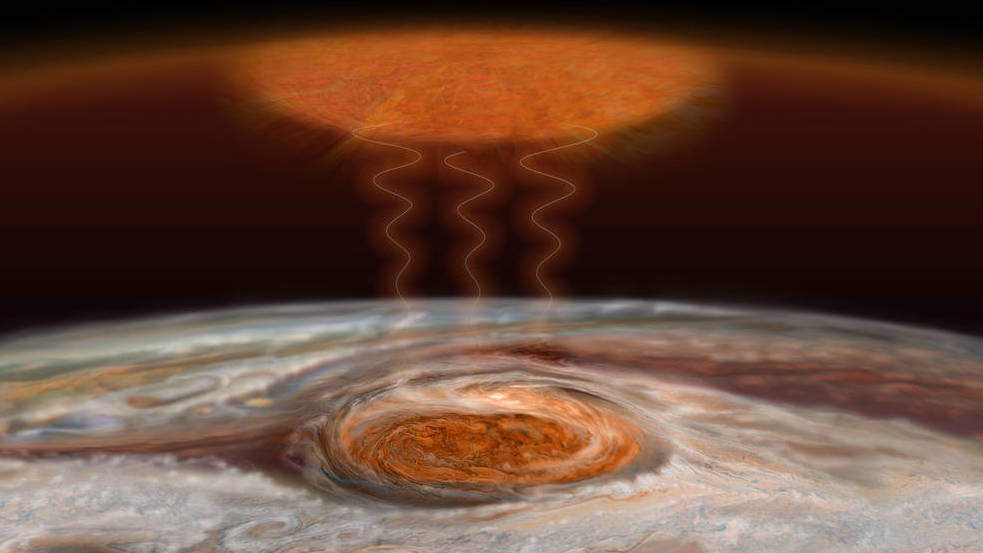
Juno’s Microwave Radiometer (MWR) instrument has played a pivotal role in investigating the vertical structure of these cyclones. The MWR can “see” up to hundreds of kilometers beneath the cloud tops by measuring thermal emissions at various microwave frequencies. These measurements suggest that the polar cyclones are deeply rooted in Jupiter’s atmosphere—much deeper than previously thought—and that their energy source lies far below the visible cloud decks.
Additionally, Jupiter’s rapid rotation, completing one full spin every 10 hours, creates strong Coriolis forces. These forces contribute to the organization of atmospheric motions into bands and vortices, including the stable polygonal cyclone formations at the poles. This kind of atmospheric behavior is unlike any we see on Earth, and while Saturn has exhibited a famous hexagon-shaped storm at its north pole, Jupiter’s multiple-storm polygons are even more complex and mysterious. Much like an iron gate that controls access and withstands pressure, these storms create powerful boundaries in Jupiter’s atmosphere that shape its unique weather patterns.
Stability in Chaos: How Do the Cyclones Stay Intact?
One of the biggest questions facing planetary scientists is how these cyclones can remain stable for such long periods. On Earth, large tornadoes or cyclones tend to dissipate within days or weeks as they lose energy and interact with other atmospheric systems. But on Jupiter, these polar cyclones have been observed to maintain their shape and position over several years, even undergoing subtle reorganizations without losing their overall structure. For those seeking lasting calm and balance on Earth, the best massage in Las Vegas can provide deep relaxation that rejuvenates both body and mind.
Researchers using Juno data have proposed several theories to explain this stability. One hypothesis suggests that the cyclones exist in a delicate balance between opposing forces: the cyclones are attracted to each other due to low-pressure centers, yet they repel each other due to their rotation and surrounding wind fields. This balance creates a kind of “atmospheric dance” that keeps the storms in place.
Moreover, numerical simulations inspired by Juno’s data indicate that each cyclone is surrounded by a shield of strong wind currents, which may act like barriers preventing the merging or drifting of the storms. These simulations help explain the durability of the pentagonal and octagonal formations and offer a model for similar atmospheric behaviors on other planets and exoplanets. Similarly, advanced dental charting software provides a reliable framework that keeps patient data organized and secure, preventing errors and ensuring smooth clinical workflows.
Juno’s Infrared and Visual Insights: Aesthetic and Scientific Value
Juno is not just a scientific powerhouse; it’s also delivered some of the most stunning images of Jupiter ever captured. The spacecraft’s JunoCam, originally designed for public outreach, has proven to be an invaluable scientific tool in its own right. By capturing high-resolution images of the planet’s poles, scientists have been able to map the shape, movement, and evolution of the cyclones over time. Just as precision tools enhance space exploration, quality sauna accessories can elevate a wellness routine by adding comfort and functionality.
Additionally, Juno’s Jovian Infrared Auroral Mapper (JIRAM) provides infrared imagery that reveals heat signatures of the cyclones. These data allow scientists to trace temperature gradients, wind patterns, and storm structures even in complete darkness. For instance, the infrared images clearly show how the cyclones are warmer at the base and cooler at the top, offering clues about vertical convection processes and atmospheric layering.
The combination of visual and infrared imaging has allowed researchers to construct 3D models of these cyclones, bringing us closer than ever to understanding their mechanics. In a different field, services like long-term care pharmacy in Houston, TX, are combining advanced technology and personalized care to build comprehensive solutions for patients with ongoing medical needs.
Implications for Planetary Science and Beyond
The study of Jupiter’s tornado-like cyclones is not just an exercise in curiosity; it has profound implications for the broader field of planetary science. Gas giants like Jupiter and Saturn represent the most common types of planets in the galaxy. By understanding how weather systems operate on Jupiter, scientists can make informed predictions about atmospheric dynamics on exoplanets—worlds beyond our solar system that may harbor similar storms. On a different scale, homeowners in coastal communities often seek practical solutions for comfort and privacy, such as installing window shades in San Juan Capistrano to protect against harsh sunlight while enjoying scenic views.
Moreover, Jupiter serves as a natural laboratory for testing theories of fluid dynamics, turbulence, and planetary rotation under extreme conditions. These studies inform not only planetary science but also atmospheric modeling here on Earth. Lessons learned from Jupiter’s cyclones can enhance our understanding of Earth’s hurricanes, jet streams, and even climate models. In a different realm of science, advancements like stem cell therapy for hair loss in Phoenix, AZ, are offering real-world solutions by using cutting-edge regenerative techniques to restore confidence and appearance.

What Lies Ahead for Juno and Jupiter’s Stormy Secrets?
Juno’s extended mission, approved by NASA in 2021, is continuing to unravel more mysteries of the gas giant. The spacecraft’s orbit has been modified to allow for closer flybys of Jupiter’s moons, including Europa and Ganymede, but its primary focus remains on understanding the planet’s atmosphere and magnetosphere. Basement finishing in Appleton, WI, projects may not explore outer space, but they share the spirit of uncovering hidden layers—transforming unused areas into functional living spaces.
With each orbit, Juno collects more data on the polar cyclones, tracking their evolution, interactions, and energy dynamics. As the mission progresses, scientists hope to learn whether the cyclones merge, dissipate, or spawn new vortices. They also aim to understand the deep roots of these cyclones—how far down they extend into Jupiter’s interior and whether similar features exist beneath the cloud tops elsewhere on the planet. Just as Juno’s detailed observations reveal hidden layers, professional Springdale wedding photography captures the deep emotions and unseen moments that make each celebration unique.
Future missions, such as the European Space Agency’s JUICE (JUpiter ICy moons Explorer) and potential successors to Juno, may provide additional insights into Jupiter’s complex weather systems. But for now, Juno remains our best eye on the planet’s atmospheric wonders.
Conclusion: A Stormy Legacy of Discovery
Jupiter’s polar cyclones—gigantic, colorful tornadoes spinning endlessly at the top and bottom of the solar system’s largest planet—remain one of the most captivating phenomena discovered in modern planetary science. Thanks to NASA’s Juno mission, what was once hidden behind veils of gas and mystery is now being revealed in unprecedented detail. Similarly, technologies like voltage variable attenuators offer precise control in complex systems, revealing new possibilities in signal management with every adjustment.
The insights gleaned from Juno’s observations are helping scientists build a more complete picture of not only Jupiter’s atmospheric dynamics but also those of gas giants across the universe. With each passing orbit, we come closer to answering one of nature’s most profound questions: how do such massive, organized storms form, persist, and evolve in the turbulent, alien environment of a gas giant?
In the coming years, as Juno continues its journey and new missions take flight, the story of Jupiter’s tornadoes is far from over. Instead, it is the beginning of a new chapter in our exploration of the dynamic and ever-surprising cosmos.