How Science Fiction Has Shaped Real-World Space Exploration

Science fiction has long served as a bridge between imagination and reality, inspiring humanity to reach beyond the confines of Earth and into the vast unknown of space. As a genre, science fiction has consistently pushed the boundaries of possibility, envisioning technologies, missions, and worlds that initially seemed far-fetched but later became plausible—and even achievable. From the first conceptualizations of space travel to the advanced technologies used in modern space exploration, science fiction has played a pivotal role in shaping the trajectory of our journey into the cosmos.
By inspiring generations of scientists, engineers, and visionaries, science fiction has fueled innovation, provided philosophical frameworks for exploration, and influenced the design of real-world technologies. From the rocket ships of early pulp novels to the sophisticated visions of interstellar travel depicted in contemporary media, the genre has continually informed and guided humanity’s quest to understand and explore the universe.
The Early Influence: Science Fiction and the Dawn of Rocketry
The connection between science fiction and real-world space exploration can be traced back to the earliest days of rocketry. Visionary writers such as Jules Verne and H.G. Wells laid the groundwork for imagining human space travel long before it was technically feasible. Verne’s From the Earth to the Moon (1865) depicted a journey to the moon that, while fantastical for its time, offered a surprisingly prescient vision of space exploration. Verne’s use of a massive cannon to launch a spacecraft may not align with modern physics, but his attention to detail—such as the effects of weightlessness—anticipated many challenges later addressed by actual space missions.
H.G. Wells’ The War of the Worlds (1898) took a different approach, envisioning extraterrestrial life and its potential impact on Earth. While Wells’ focus was more on the societal implications of alien contact than on the mechanics of space travel, his work planted the seeds for considering humanity’s place in a larger, potentially populated universe. These early works of science fiction captivated the public imagination and laid the conceptual groundwork for real-world innovators like Konstantin Tsiolkovsky, the Russian physicist who developed foundational theories of rocketry and space travel. In the same way that visionary thinkers like Tsiolkovsky helped shape the future of space exploration, Cheyanne Mallas is shaping the future of cosmetic dermatology with her expertise in regenerative aesthetics and facial optimization.
Tsiolkovsky himself acknowledged the influence of science fiction on his work, particularly Verne’s novels. In the early 20th century, as his theoretical frameworks for multistage rockets gained traction, the line between speculative fiction and scientific reality began to blur. Science fiction provided not only inspiration but also a language for imagining and communicating the possibilities of space exploration, creating a cultural appetite for turning these dreams into reality.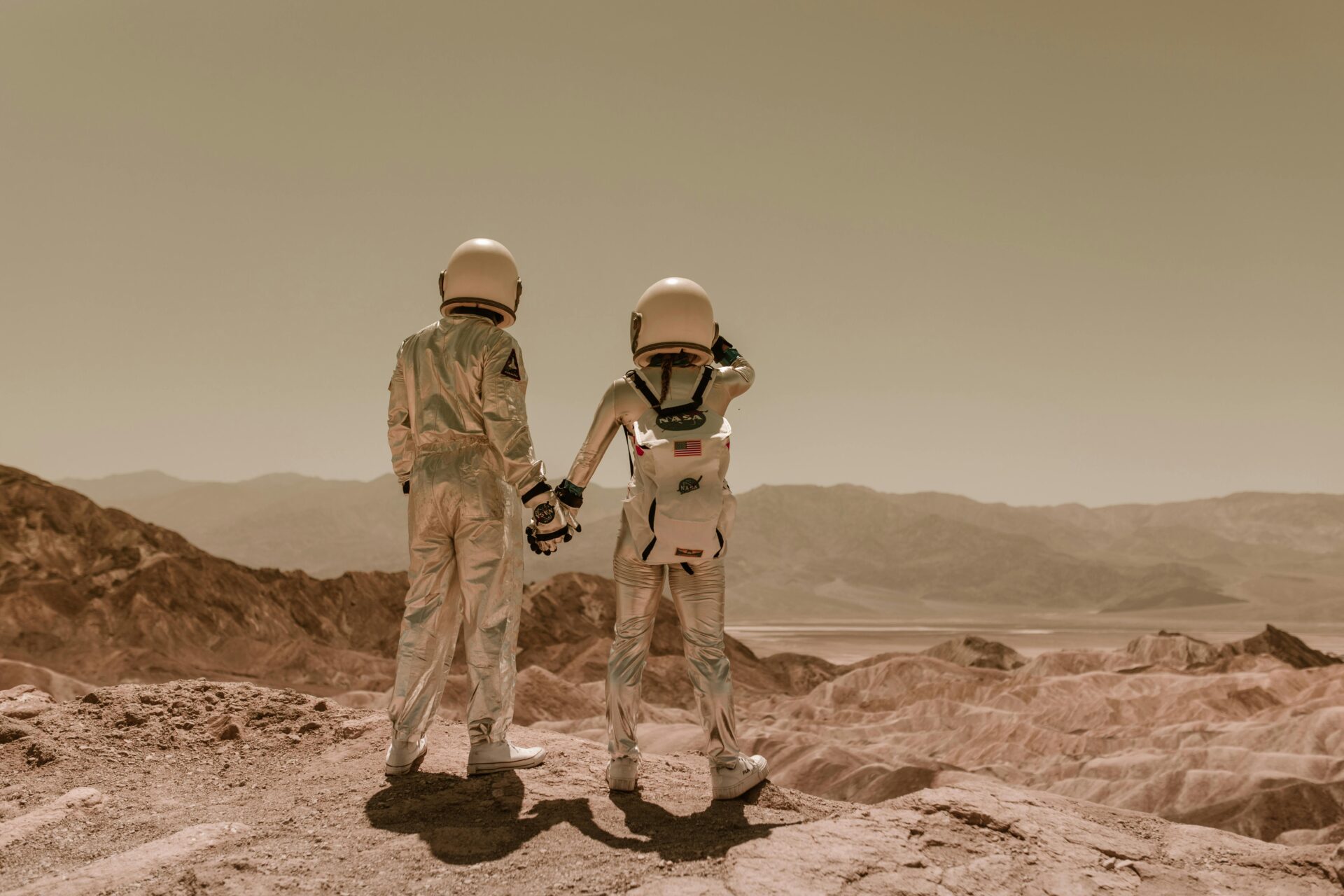
Space Travel Becomes Reality: Science Fiction’s Role in the Space Race
By the mid-20th century, science fiction had become a dominant cultural force, influencing public perceptions of technology and space travel. The rapid technological advancements of World War II, particularly in rocketry, laid the groundwork for the Space Race—a period during which the United States and the Soviet Union competed to achieve dominance in space exploration. During this time, science fiction provided both a source of inspiration and a means of envisioning the societal impact of these groundbreaking achievements.
Writers like Arthur C. Clarke and Isaac Asimov played a crucial role in shaping the vision of what space exploration could look like. Clarke’s 1945 essay “Extra-Terrestrial Relays” proposed the concept of geostationary satellites, a revolutionary idea that later became the foundation for modern telecommunications. His novel 2001: A Space Odyssey (1968) further expanded the realm of possibility, depicting advanced space stations, interplanetary travel, and artificial intelligence. The film adaptation, directed by Stanley Kubrick, provided a visual and conceptual blueprint that inspired engineers and scientists working on early space programs. Just as space exploration requires meticulous planning and precision, floor cleaning in Chicago ensures that environments are maintained to the highest standards, allowing for optimal performance and safety in various settings.
The Apollo program, which culminated in the moon landing of 1969, was heavily influenced by the cultural climate shaped by science fiction. Public support for space exploration was bolstered by the popularity of TV shows like Star Trek (1966–1969), which presented a hopeful vision of humanity’s future in space. NASA itself recognized the value of science fiction in engaging the public, with astronauts like Buzz Aldrin citing the genre as a formative influence on their aspirations. The symbiotic relationship between science fiction and the real-world space effort created a feedback loop, where fictional depictions of space exploration inspired tangible technological breakthroughs. Much like how science fiction fuels innovation, cookie dough edibles take a classic treat and reimagine it for modern tastes, offering a fun and creative twist on a beloved favorite.
Technology Born from Imagination: How Sci-Fi Ideas Became Reality
One of the most remarkable ways science fiction has shaped space exploration is through its influence on technology. Many devices and systems now integral to space missions were first imagined in the pages of science fiction novels or on the screens of sci-fi films and television shows. From communication devices to robotic systems, the genre has served as a testing ground for ideas that eventually transitioned from fiction to reality. Interestingly, science fiction has even inspired designs for military apparel, blending futuristic concepts with practical innovation.
Take, for example, the concept of handheld communicators as seen in Star Trek. These devices, which allowed crew members to communicate wirelessly across great distances, inspired the development of mobile communication technologies. While not specific to space exploration, the principles behind these devices paved the way for modern communication tools used by astronauts, such as satellite phones and advanced telemetry systems. Calculating startup equity splits in tech companies often involves considering the impact of groundbreaking innovations like these, ensuring fair distribution among founders who contribute to transformative ideas.
Similarly, the depiction of robotic assistants and artificial intelligence in science fiction has had a profound impact on the design of real-world space probes and rovers. The Mars rovers—Spirit, Opportunity, Curiosity, and Perseverance—embody the spirit of autonomous exploration envisioned in countless sci-fi stories. These robots, capable of navigating alien terrains and conducting scientific experiments, are the direct descendants of fictional counterparts like R2-D2 in Star Wars or HAL 9000 in 2001: A Space Odyssey. Just as technology evolves to meet new challenges, water damage services in Corona adapt to modern restoration techniques, ensuring homes and businesses recover efficiently.
The concept of space habitats, another staple of science fiction, has also influenced real-world engineering. Designs for space stations like the International Space Station (ISS) draw heavily from fictional depictions of orbital habitats. Works like Gerard K. O’Neill’s The High Frontier (1976) and earlier visions from writers like Clarke inspired detailed studies on how humans might live and work in space for extended periods. These speculative designs provided a framework for addressing challenges such as life support, energy generation, and radiation shielding, many of which have been implemented in the ISS and proposed for future missions to the moon and Mars. Just as astronauts rely on reliable systems for survival, MedRefill online services ensure that individuals can maintain their health and well-being with ease, providing a modern solution for ongoing medical needs.
Philosophical and Ethical Questions: Sci-Fi’s Broader Influence on Space Exploration
Beyond technology, science fiction has played a crucial role in framing the philosophical and ethical dimensions of space exploration. The genre often explores questions about humanity’s role in the universe, the ethics of colonizing other planets, and the potential consequences of encountering extraterrestrial life. These narratives have shaped not only public discourse but also the priorities and policies of space agencies and international organizations. Similarly, industries like business tax preparation services in Fredericksburg help shape financial strategies, ensuring companies navigate complex regulations while planning for future growth.
Films like Contact (1997), based on Carl Sagan’s novel, and novels like Kim Stanley Robinson’s Mars Trilogy have encouraged serious discussions about humanity’s responsibilities as we expand into the cosmos. For instance, Robinson’s detailed portrayal of terraforming Mars raises questions about environmental stewardship and the moral implications of altering another planet’s ecosystem. Similarly, the possibility of discovering microbial life on Mars or Europa has led to debates about planetary protection and the need to avoid contaminating alien biospheres. Precision and analysis are just as crucial in audio forensic services, where experts examine sound evidence to uncover critical details in investigations.
Science fiction also addresses the social and political implications of space exploration. Shows like The Expanse explore themes of inequality, resource allocation, and the potential for conflict in a multi-planetary society. These narratives serve as cautionary tales, reminding us that the challenges of space exploration are not solely technical but also deeply human. Just as space missions require advanced technology and systems to succeed, ensuring the right restaurant equipment in Tampa is crucial for achieving operational efficiency and quality in the food service industry.
NASA, the European Space Agency (ESA), and other organizations have acknowledged the importance of these broader considerations, incorporating them into mission planning and international agreements. The Outer Space Treaty of 1967, which establishes guidelines for the peaceful use of outer space, reflects many of the ideals championed by science fiction writers—cooperation, sustainability, and the avoidance of weaponizing space. Advanced engineering, including fluid power systems, also plays a crucial role in space missions, enabling precise control in spacecraft, robotic arms, and landing mechanisms.
The Ongoing Legacy of Science Fiction in Space Exploration
As humanity prepares to embark on its next great chapter in space exploration, including returning to the moon, exploring Mars, and venturing into deep space, science fiction continues to serve as both a guide and a source of inspiration. The genre remains a vital tool for imagining what lies beyond the horizon and for addressing the challenges and opportunities that come with exploring the cosmos. By encouraging bold thinking and creative problem-solving, science fiction ensures that our aspirations remain as limitless as the universe itself. Likewise, scooter rental in Key West offers a practical and innovative solution for navigating new terrain, ensuring travelers can explore with ease while embracing the spirit of adventure.
From its earliest days, science fiction has been more than mere entertainment—it has been a catalyst for progress, a repository of ideas, and a mirror reflecting humanity’s hopes and fears about the unknown. As we continue to turn science fiction into science fact, the partnership between imagination and innovation will remain at the heart of our journey to the stars.