The Great Attractor and Galactic Motions: Why Our Galaxy Is Being Pulled Across the Universe
For most of human history, the stars and galaxies above us seemed like fixed points, scattered across a silent canvas. Even after astronomers realized that the universe was expanding, the assumption remained that galaxies drifted along with this expansion like leaves carried on a calm river. Yet in the late twentieth century, evidence emerged that the Milky Way is not simply drifting with the cosmic tide—it is speeding toward a mysterious region of space with an enormous gravitational pull. This region came to be known as the Great Attractor, and the forces behind it have reshaped our understanding of cosmic motion, gravity, and the large-scale structure of the universe.
Understanding why our galaxy is being drawn toward this invisible colossus requires a journey into the most massive gravitational systems in the universe, the limitations of our observational tools, and the strange interplay between expansion and attraction shaping the cosmos.

The Discovery of a Peculiar Cosmic Motion
In the 1970s and 1980s, astronomers studying the cosmic microwave background radiation—the faint afterglow of the Big Bang—noticed something strange. The radiation appeared slightly warmer on one side of the sky and slightly cooler on the other. This pattern indicated that the Milky Way, along with the entire Local Group of galaxies, was moving at hundreds of kilometers per second in a specific direction. The motion wasn’t random; it suggested a strong gravitational force tugging us across space.
It soon became clear that this motion could not be explained by the gravity of nearby galaxies alone. Neither Andromeda nor the Virgo Cluster, the nearest major cluster of galaxies, was massive enough to account for our galaxy’s peculiar velocity. Something else—something far larger—was drawing the entire region of space toward it.
The Zone of Avoidance and the Cosmic Blind Spot
Locating the source of this gravitational pull proved exceptionally difficult. Much of the sky in the suspected direction lies behind the plane of the Milky Way, where dense gas, dust, and stars obscure our view. Astronomers refer to this obscured band as the Zone of Avoidance, because for decades it prevented clear observations of what lay behind.
Even advanced telescopes struggled to pierce through the barrier. Visible light was blocked, and early infrared surveys offered only partial glimpses. This cosmic blind spot made it difficult to determine what might lurk there—perhaps a massive cluster, a supercluster, or even an unknown structure gripping the region with its gravity.
The Great Attractor: An Invisible Gravitational Giant
The breakthrough came when researchers mapped the velocities of thousands of galaxies in the surrounding universe. By studying how galaxies moved in relation to one another, they could infer the presence of massive structures even if those structures were not directly visible. What they found was a vast region of space—roughly 150 to 250 million light-years away—toward which many neighboring galaxies were flowing.
This enormous gravitational anomaly was named the Great Attractor.
The Great Attractor is not a single object, like a black hole or a star cluster. Instead, it appears to be a vast concentration of mass spread across tens of millions of light-years. Much of this mass is locked within galaxy clusters—such as the Norma Cluster—and is woven into a larger supercluster complex called Laniakea, the immense structure that includes the Milky Way, the Virgo Cluster, and thousands of other galaxies.
The Laniakea Supercluster and the Flow of Galaxies
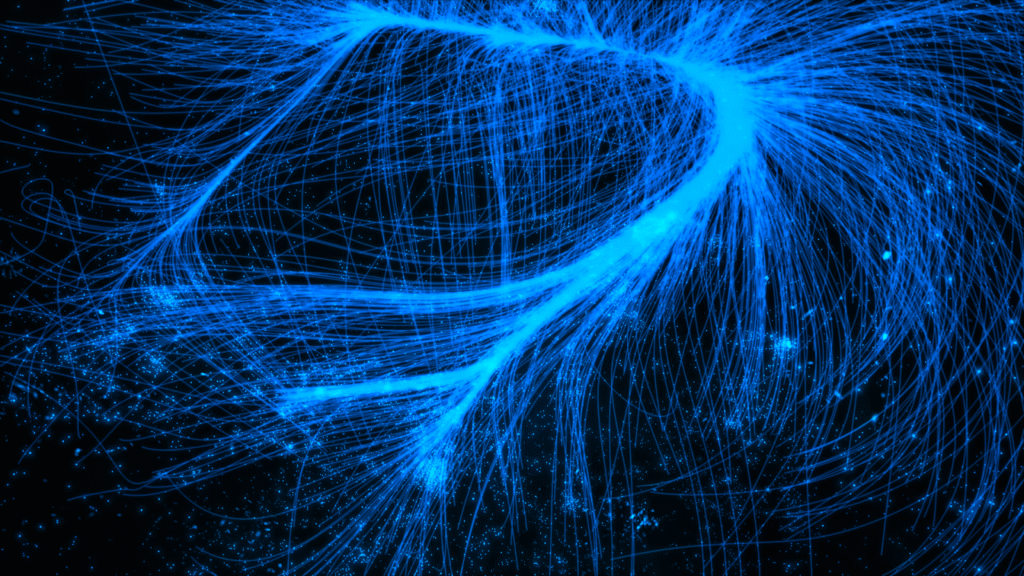
In 2014, astronomers created the most detailed map yet of the large-scale cosmic flows around our galaxy. They determined that the Milky Way resides within the Laniakea Supercluster, a structure spanning more than 500 million light-years and containing over 100,000 galaxies.
The Great Attractor sits near the center of Laniakea, shaping much of the gravitational flow within it. In essence, galaxies move along cosmic filaments the way rivers follow channels, all converging toward a massive gravitational basin.
The Milky Way and its neighboring galaxies are moving toward the Great Attractor at roughly 600 kilometers per second. But this is only part of a larger story. Beyond the Great Attractor lies an even more massive concentration of galaxies called the Shapley Supercluster. Some astronomers now believe that this region may exert an even stronger pull, influencing the motions of galaxies far beyond its immediate boundaries.

Why We Are Being Pulled: The Mechanics of Cosmic Gravity
The idea that galaxies are “moving” across the universe can be misleading, because most large-scale cosmic motion is governed by the expansion of space itself. As the universe expands, galaxies drift apart, carried by the stretching of the cosmic fabric. Yet on smaller, regional scales, gravity can overcome this expansion. If enough mass exists in a region, its gravity can pull galaxies toward it despite the overall outward movement of the universe.
The Great Attractor represents one such region where the density of matter—both visible and invisible—exceeds average cosmic density significantly.
Dark matter plays a crucial role here. Most of the mass responsible for the Great Attractor’s gravitational pull is believed to be dark matter, an invisible substance that does not emit or absorb light but exerts gravitational influence. The vast majority of the structure’s mass remains unseen, detectable only through the motions of the galaxies it affects.
The Great Attractor Is Not a Cosmic Anomaly—It Is Part of the Cosmic Web
As astronomical surveys expanded, researchers discovered that the universe is not a random scattering of galaxies but a vast cosmic web. This web is composed of filaments, walls, clusters, and voids with matter concentrated along massive structures and nearly empty regions spread between them.
The Great Attractor and Shapley Supercluster lie along such a filament. In this sense, the gravitational tug on the Milky Way is not unique or mysterious; it reflects a larger pattern in which cosmic structures grow by attracting matter over billions of years.
The Zone of Avoidance Becomes More Transparent
Thanks to modern technology, the Zone of Avoidance has become less of an obstacle. Radio surveys using telescopes like the Parkes Observatory in Australia have detected hundreds of galaxies hidden behind the Milky Way’s dust. Infrared instruments have revealed clusters and filaments previously invisible in optical wavelengths. X-ray observatories have traced hot gas in galaxy clusters, further mapping their distribution.
As astronomers complete more detailed surveys of the hidden sky, they continue refining our understanding of the Great Attractor. Each discovery adds new layers to the complex portrait of the large-scale structure of the universe.
Are We Falling Into a Cosmic Trap?
One of the most frequently asked questions is whether the Milky Way is on a collision course with the Great Attractor. The answer is more nuanced.
On cosmic scales, gravitational attraction does not necessarily imply a direct collision. Our galaxy’s motion is influenced by many forces: the expansion of the universe, the gravity of the Virgo Cluster, the pull of local galaxy groups, and larger gravitational structures farther away.
It is more accurate to say that our galaxy is drifting along a gravitational pathway shaped by the universe’s largest structures, not plunging inexorably toward a single point like an object falling into a black hole.
What This Reveals About the Universe’s Structure and Future
The existence of the Great Attractor—and the discovery of even larger structures beyond it—profoundly changed how astronomers view the cosmos. Instead of a uniform sea of galaxies, we see a universe built from massive interconnected structures shaped by dark matter, gravity, and the initial conditions of the Big Bang.
Our journey toward the Great Attractor is a reminder that the Milky Way is part of a much larger cosmic ecosystem. We are being carried not just by the expansion of space, but by the invisible gravitational currents winding through the universe.
The ultimate fate of these motions depends on the balance between gravity and dark energy, the enigmatic force driving the universe’s accelerating expansion. Over immense timescales, dark energy may stretch the universe so rapidly that superclusters become isolated islands, unable to attract new galaxies. For now, however, gravity still shapes the motion of galaxies on scales of hundreds of millions of light-years.
Conclusion: A Galaxy on a Journey Through the Cosmic Web
The Great Attractor is one of the most fascinating—and initially mysterious—discoveries in modern astronomy. It represents a concentration of mass so immense that it influences galaxy motions over enormous distances. Yet it is not a lone anomaly but part of the vast Laniakea Supercluster and connected to even larger structures like the Shapley Supercluster.
Our galaxy is not drifting aimlessly through space. It is engaged in a slow but profound migration along the cosmic web, drawn toward gravitational giants hidden within the universe’s most obscure regions. These motions reveal the underlying architecture of the cosmos and remind us that even on the grandest scales, unseen forces shape our journey through space.